On March 6, QTC's Academic Committee and Publicity Department jointly held a special seminar discussing vocational education by virtue of the newly issued article Steve Jobs' Tools Kit and Vocational Education in the nation-wide newspaper Guangming Daily.
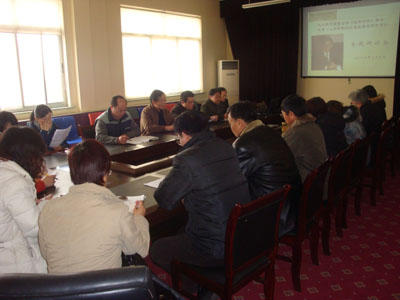
The Seminar
A written interview with the college's president Dr. Shi Zhongjian by the newspaper, the article focuses on the rethinking and fresh new ideas of China's vocational education beginning with an the enlightening case of Steve Jobs' tool case written in his biography.
All Academic Committee members and some teaching faculties reps attended the seminar. Vice Director Xie Shuiqing from the Publicity Department introduced the article that reflected the college's great achievements of the past years and also the great impacts of the college's educational concepts in China’s vocational education.
The participants all expressed their own perspectives to the article, believing the ideas and deep thinking of China's vocational education would surely exert great influence on the college's further development.
In his conclusion talk, Professor Li Yongsheng, Director of Academic Committee, emphasized wider discussions and study of the article would be further held to find more efficient and proper ways for the college's teaching and training. (Translated and edited byLi Chengji)
For reference, the English version of the article is as follows:
Steve Jobs' Tools Kit and Vocational Education
ByDr. Shi Zhongjian, President of Qingdao Technical College
FromGuangming Dailyon January 21, 2012
In Steve Jobs, there is such a story about Steve Jobs: for his fascination to electronic products, his father bought him a Heath toolkit, which comprises of various colored numbered cards and components, yet in order to easily make up electronic units following the instructions, Jobs needed to assemble the tool sets by himself. Jobs recalled, “it makes you aware that you can assemble and get to know anything. I am so lucky as to know that I can work out anything when I was still a child. I owe this to my father and my Heath toolkit. ”
More than a decade, China's vocational education achieves both a fast speed and a large scale, yet as for its educating concepts and modes, there exist too many kinds, confusingly guiding its further development. However, the story of Jobs' toolkit gives us interesting enlightenments for our education especially our vocational education in terms of both concepts and modes. The great achievements made by legendary Steve Jobs surprise the world, which, undoubtedly, owes greatly to his step father's fostering manner from his early childhood. The do-it-yourself education had inspired his great interest to the world and cultivated his practice-oriented creativity, which provides a universal and successful case in point for vocational education.
Can't we say this is not what our vocational education and even the whole education strive for?
Buddhism upholds all emptiness and supramundane minds, yet the Buddhism School of the renowned Lingyin Temple is just located inside its manors, and the minds of the recluses are not absolutely immune from their own realistic world also. It would be all right for our education to energetically integrate into the social development. Undoubtedly, either the astronauts with the high-end technologies, or the skillful doctors, or the singers, or even the elites in the scientific world are all trained in a setting of vocational education. From this point of view, we can affirm vocational education is definitely the one for successors instead of for losers. The higher education does not educate idlers or recluses but what we call professionals. Can't we say scientists, researchers, and engineers are not professionals? At the end of last century when I was a visiting scholar in Vienna University, I found the world renowned universities like Vienna University, didn't simply educate the scientific talents, but also laid great emphasis on such general social trainings as foreign language training for the immigrants, simple skills training for the citizens of the communities etc. Accordingly, universities or colleges can not break away themselves from the outside social world and become what some people might say sacred.
Seeking for application is for effectiveness. In many places of China, we can see many universities or colleges towns where stand so many high buildings. We don't deny their roles, yet colleges or universities do not simply mean them. Rather, colleges or universities are cradles for cultures, lands of spirits. To this day, Qingdao Technical College still uses the student dorm converted offices for its administrative staff, and let alone the usual colorful fountains, grand college gate etc. Yet, we spare no effort and expense for our practical training facilities and our staff's training. The National Numerical Control Technology Training Center for Vocational Education, The National Electrical & Electronic Engineering and Automation Technology Training Center for Vocational Education, The Practical Training Center for Qingdao Higher Vocational Education are currently based at the college. In recent 5 years, QTC has sent 145 of its teaching staff to receive training or do researching projects in 11 countries or regions such as Germany, Canada, and The United States etc, which involving more than RMB 10 million Yuan for the training expenses. The emphasis on quality consolidation greatly benefits QTC: One of the first National Exemplary Higher Vocational Colleges, A winner of Outstanding Rectors of China Vocational Education, An Advanced Institute for National Vocational Education, 2 second prizes in the 6th National Teaching Achievements Awards, nearly 100 students wining in the skills competitions of provincial and national levels yearly, more popularity of its graduates in spite of the current employment difficulties.
However, application does not mean simplicity and superficiality, which instead should integrate beauty and elegance. A thought not only reflecting the delicacy and application of professions but also Germany's aspiration for art, the German born Bauhaus Thought has influenced the world for more than 50 years, and still keeps its position of a golden rule in the design world. The thought, as a typical combination of art and technology, science and application, is both a mixture of philosophy and products aesthetics, philosophy and social demand, and a particular expression of vocational and practical education. Its theories and the practices tell us application also requires a high level of standards and abundant technologies.
In China, many universities or colleges, as we find, are becoming to some extent conscious of the importance of practice oriented teaching, successively cooperating with enterprises and following the German Dual System. yet, China, as far as I know, still has a long way to go to reach the essence of Germany's vocational education.
After the field investigation and a comparative study of Germany vocational education in 2002, I found besides the two core elements of educational institutions and enterprises, there also existed three other ones, which firstly referred to the sound legal system of national and state level regulating the cooperation between colleges and enterprise; secondly to Nordic's traditional culture of admiring technologies, which greatly affected every corner of the society, say, the high social status of an excellent cook or glass potter etc; thirdly to its immense postwar demand for the social and economic development. However, we, by comparison, needn't go to great lengths to find that in spite of the enormous economic demand, we are still not so clear in choosing what kind of professionals, and lack of a sound relevant legal system, cultural and social atmosphere of advocating technologies. What is worse, we even more greatly fall behind Germany in terms of the first two elements' cooperation. (Translated by: Li Chengji)

